01
24-Cell
Four dimensions
The solid only four dimensions have — twenty-four octahedra — seeming to turn itself inside out.
Broken Signal 132 BPM
22 rooms, 22 house tracks,
and any track plays in any room —
Then twelve keys, minor or major, twelve chord progressions in each, and the tempo is yours to set. We stopped counting there. The number isn't the point. The point is that all of it is yours to change.
Making music has usually meant years of lessons, or software that assumes you already know what a minor ninth is. The best part — hearing something you made come together — sits on the far side of all that. We didn't think it should.
So Calabi keeps the theory for you. The key, the chords and the notes the lead can play are worked out already; your part is deciding what sounds good. And while you play, a shape from real mathematics moves to what you make.
Every room opens on a house track to start from, and the picture moves to it: the kick swells the shape, the chords change it, a fill breaks it apart until the crash brings it home. Then we handed you the tools to make it yours.
Draw across the screen and the lead plays only notes from the track's key. Tap and you get the chord the track is on. Change the key and everything follows. You can't play a bum note.
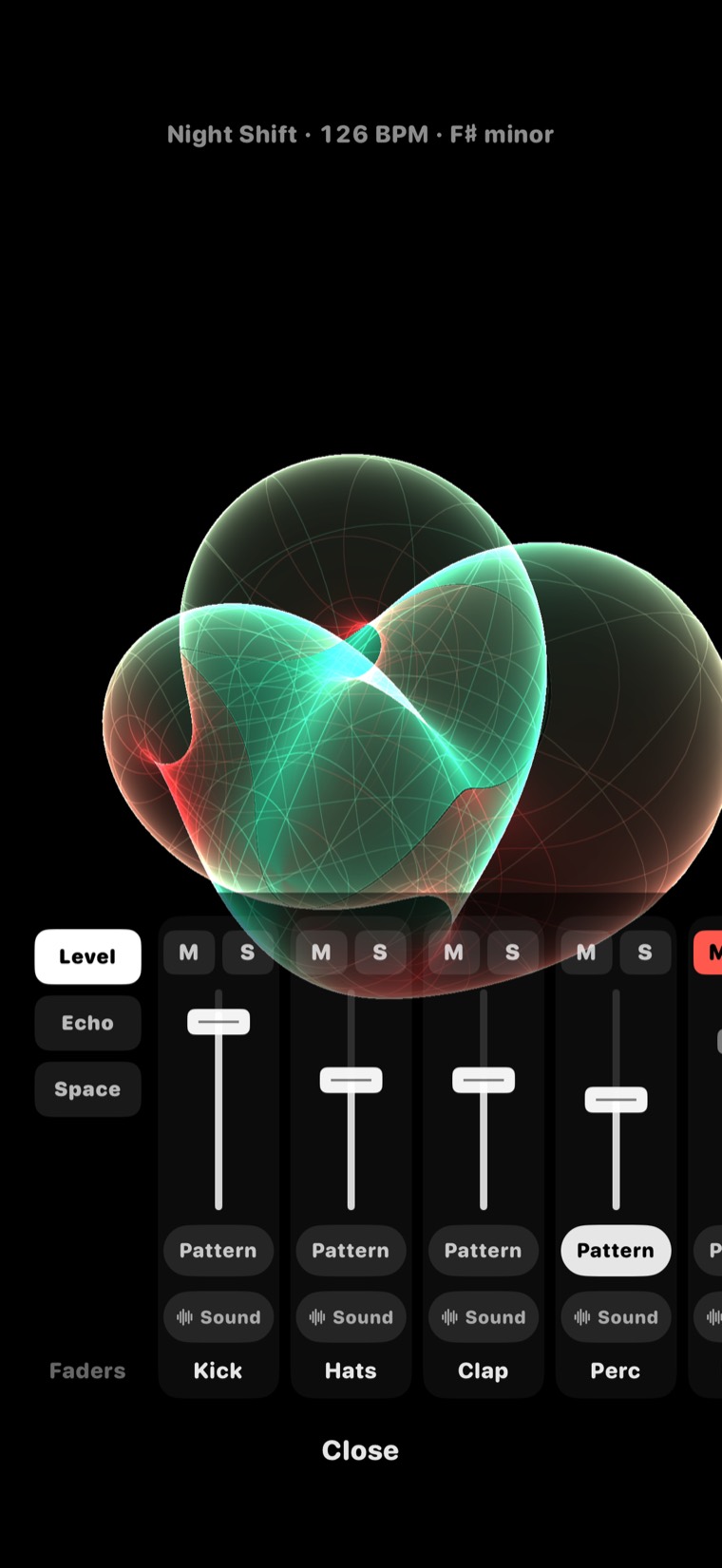
Kick, hats, clap, percussion, bass, arpeggio, hook, chords and lead — each with mute, solo, level, pattern and sound, and its own send to the echo and the reverb.
Every sound is made live on the device as it plays: the kick is a sine wave diving in pitch, the hats are six square waves at clashing pitches. The one recording is a grand piano. That's why key, tempo and sound change instantly.
And if you'd rather watch: DJ arranges the music for you and VJ plays the picture, so a room can run itself. Your hands always win — touch the filter or a mute and DJ leaves it to you for a while.
— Ricky Chopra, who made this
No keyboard, no notes to learn. Your hands do three things on the picture, and behind them every part of the track has its own controls.
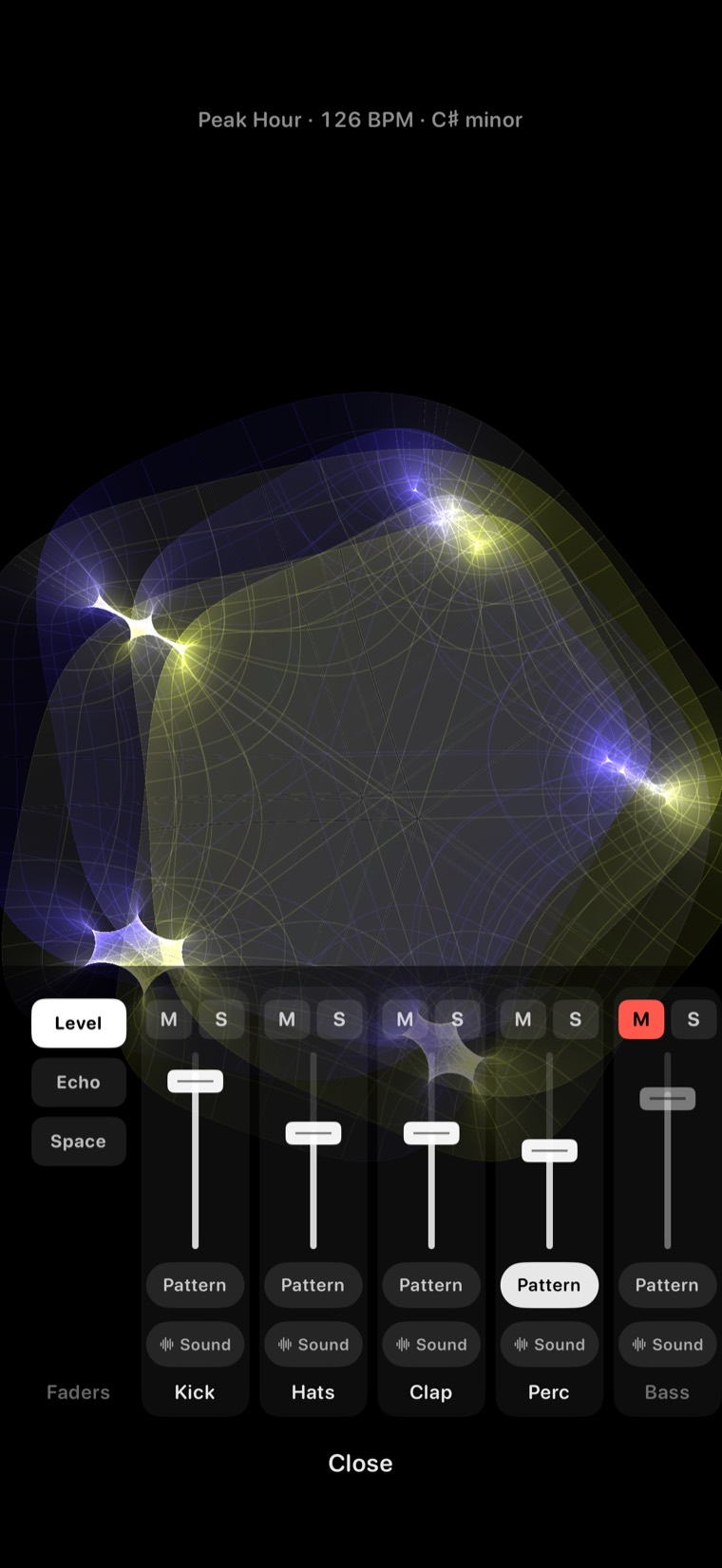
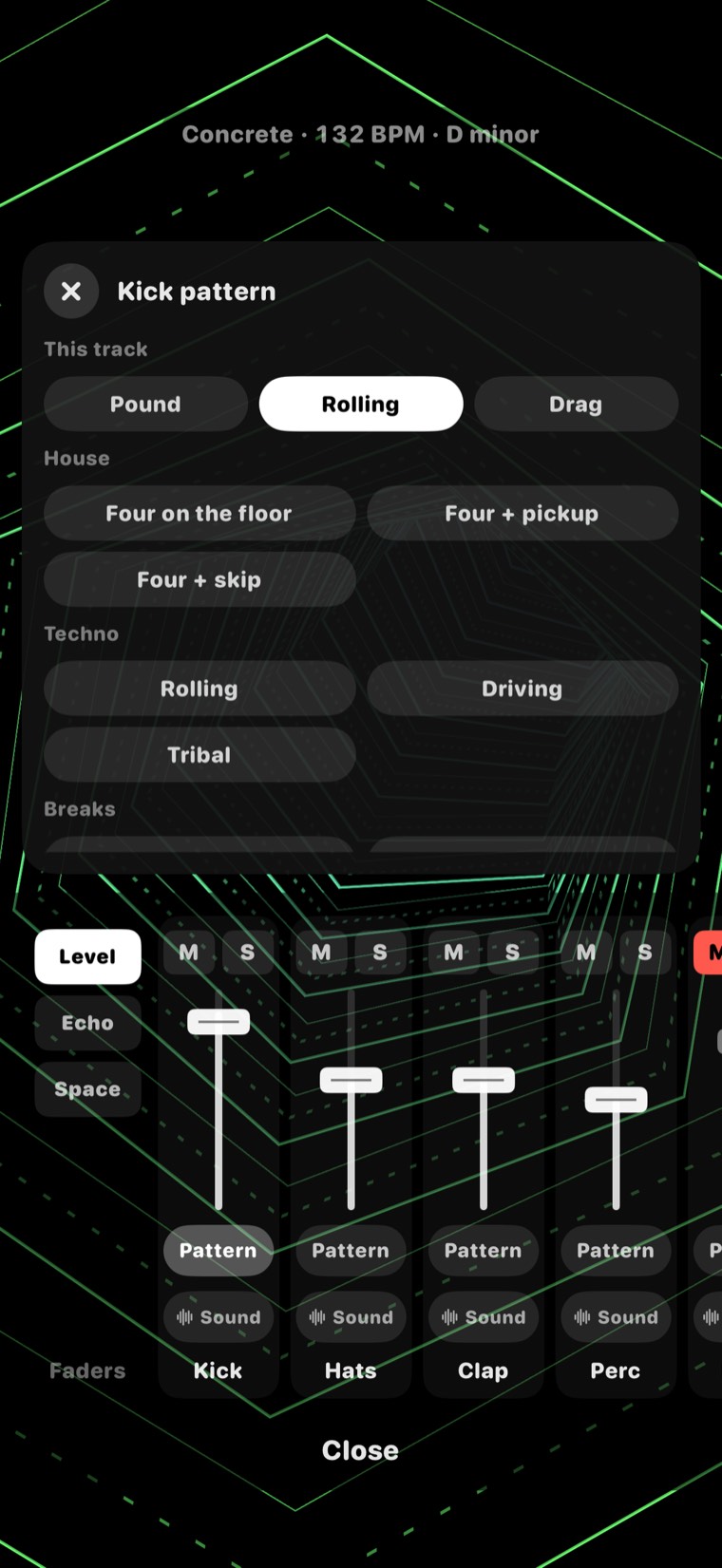
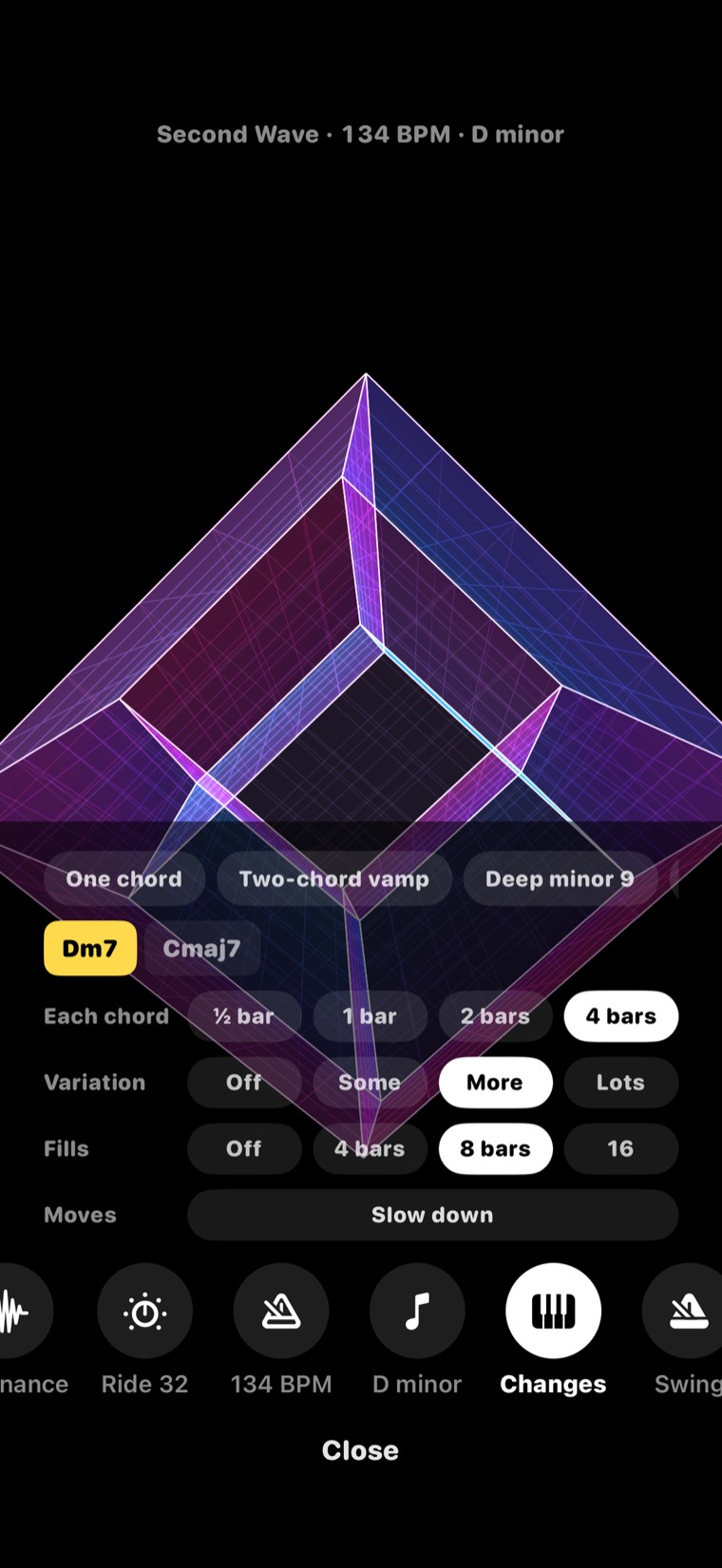
Real screens from the app, including a few of our own mixes.
You never start from a blank page. Every room hands you a finished track, and everything in it is yours to change.
Every sound in Calabi is made live by your iPhone or iPad as it plays. There are no loops and no recorded samples, with one exception: the grand piano, which is a real concert grand. That's why the key, the tempo and every sound can change the instant you touch them.
The kick is a sine wave diving in pitch with a click on the front. The hats are six square waves at clashing pitches, filtered to a shimmer. The clap is noise struck four times a few milliseconds apart. Each kit changes the shape of each.
Saw, square, FM, organ, pluck and more, through a filter modelled on the classic analogue ones. The sub bass is a pure sine wave.
Voiced so the top note moves as little as possible from chord to chord, the way a keyboard player's hands would.
An echo that bounces left and right in time with the track, a reverb, a chorus, a gentle compressor that glues the mix together, and a soft clip so it's loud without breaking up.
The House Piano is a concert grand recorded by the University of Iowa Electronic Music Studios, whose recordings may be used for any project. With thanks.
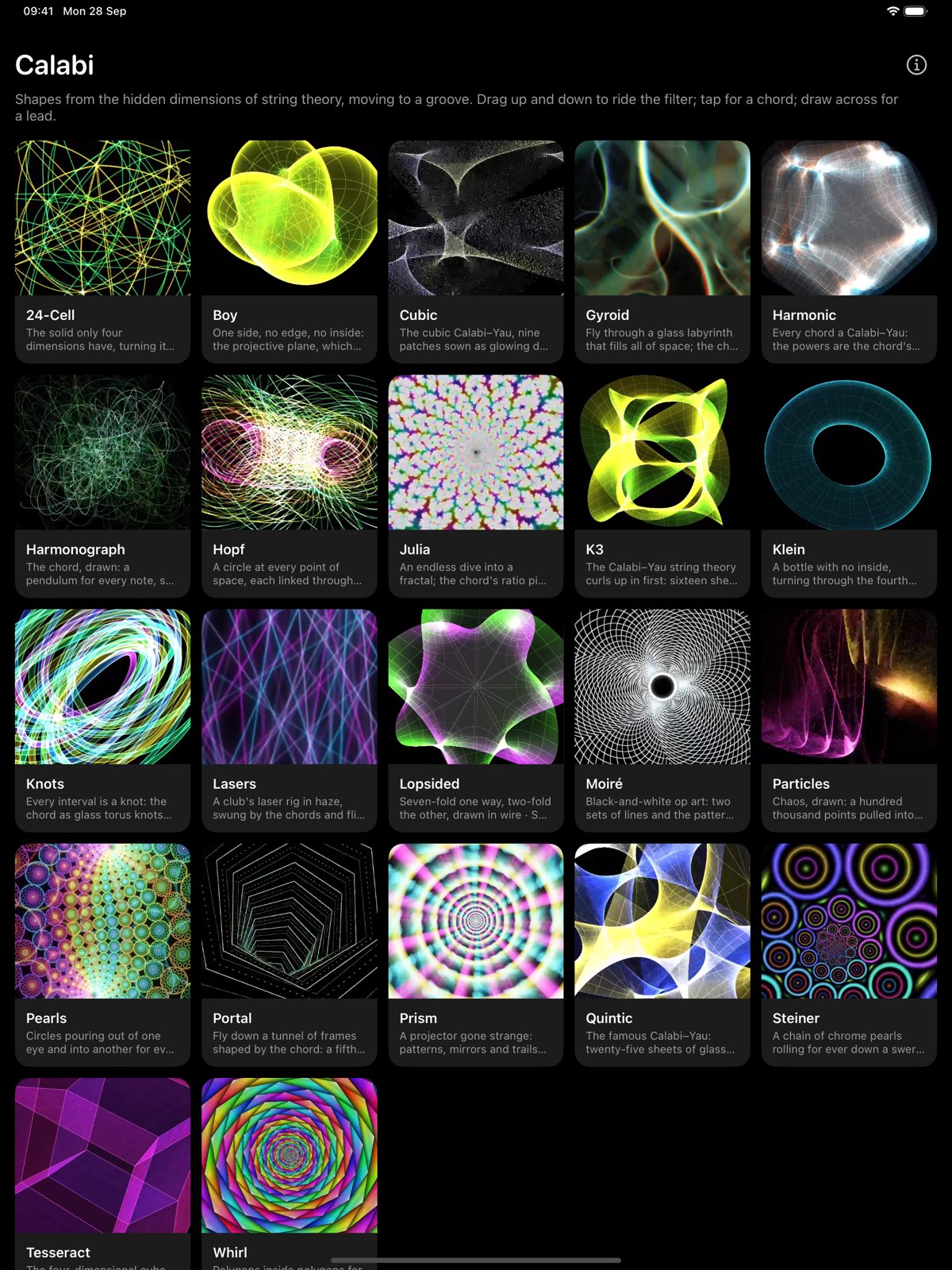
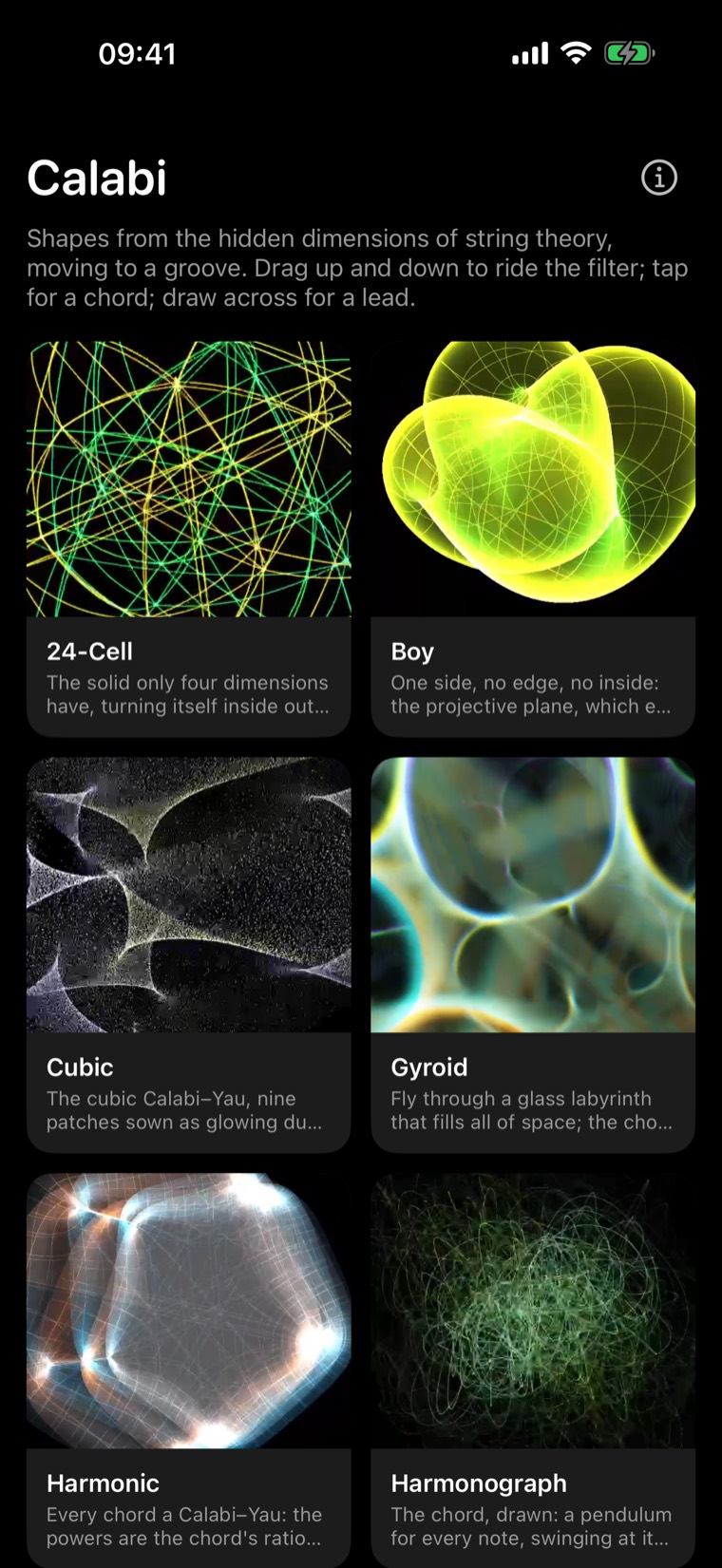
Each one a shape from mathematics, and each opening on its own track.
The solid only four dimensions have — twenty-four octahedra — seeming to turn itself inside out.
One side, no edge, no inside. Each chord turns it inside out about a point of its own.
Nine patches drawn as tens of thousands of points of light. The hats set it sparkling.
Fly through a glass labyrinth that fills all of space; the chord bends it towards its kin.
Every chord a Calabi–Yau: a fifth, at 3:2, makes a 3-by-2 surface. The maths of the music is the maths of the picture.
A pendulum for every note of the chord. Consonant chords close into calm loops; dissonant ones wander.
A circle at every point of space, each one linked through every other exactly once.
An endless dive into a fractal; the chord's ratio picks how many arms it has.
The shape string theory first curled its extra dimensions into: sixteen sheets of glass, four by four.
A bottle with no inside, turning through the fourth dimension. On a fill it splits into two Möbius strips.
Every interval in the chord as a glass knot. A fifth is a trefoil.
A club's laser rig in haze, swung by the chords and flicked by the hats.
Seven-fold one way, two-fold the other: fourteen patches in a lopsided knot, drawn in wire.
Two sets of fine lines, and a third pattern shimmering between them that's in neither.
A hundred thousand points pulled into strange attractors — Lorenz's butterfly among them — a new one each chord.
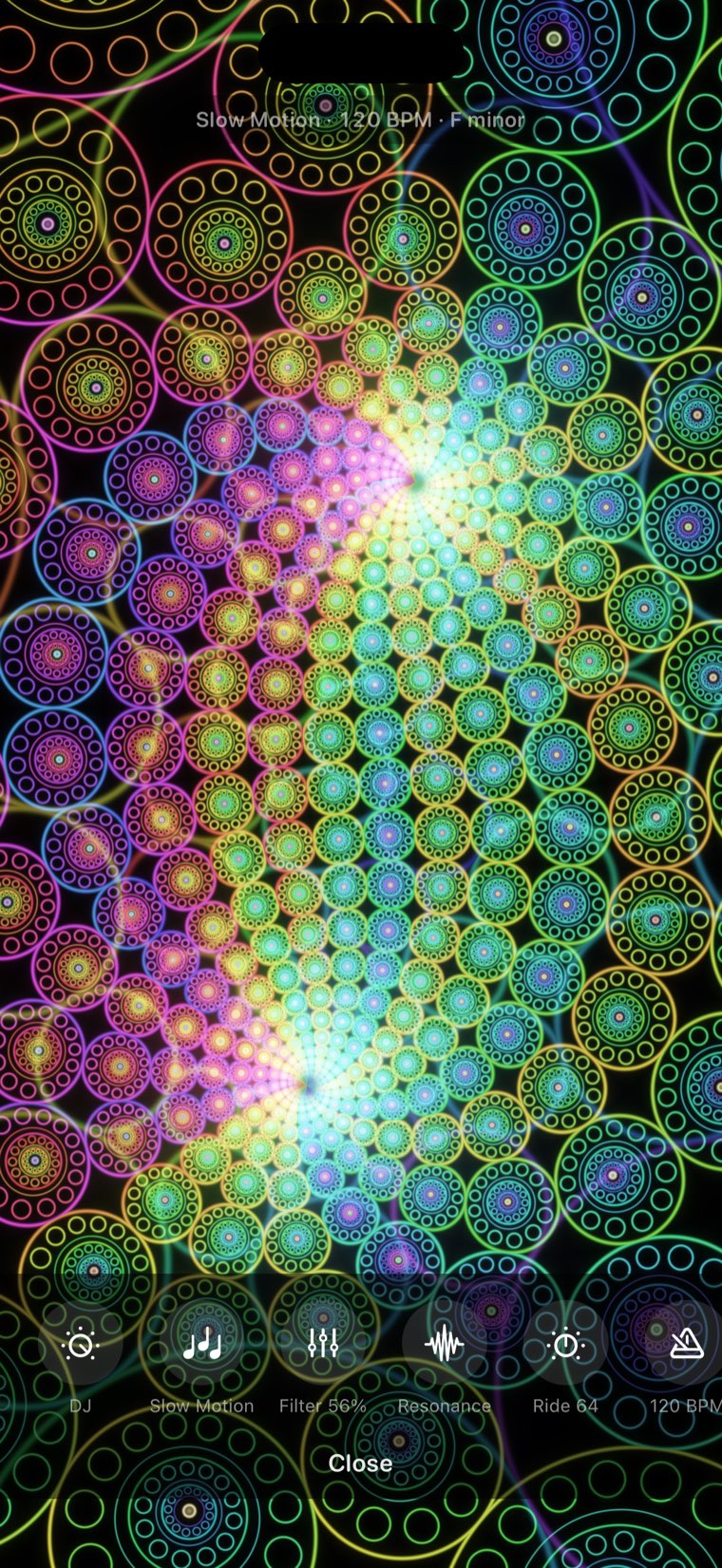
Indra's pearls: circles pouring out of one glowing eye and into another, for ever.
Fly down a tunnel of frames shaped by the chord: a fifth a triangle, a major third a pentagon.
A projector gone strange: patterns split into red, green and blue and poured down a tunnel of their own trails.
The famous one: twenty-five sheets of glass folding through a fourth dimension. The kick swells it.
A chain of chrome pearls rolling for ever down a swerving tunnel of rings.
The four-dimensional cube. On a fill it unfolds into the cross of eight cubes Dalí painted.
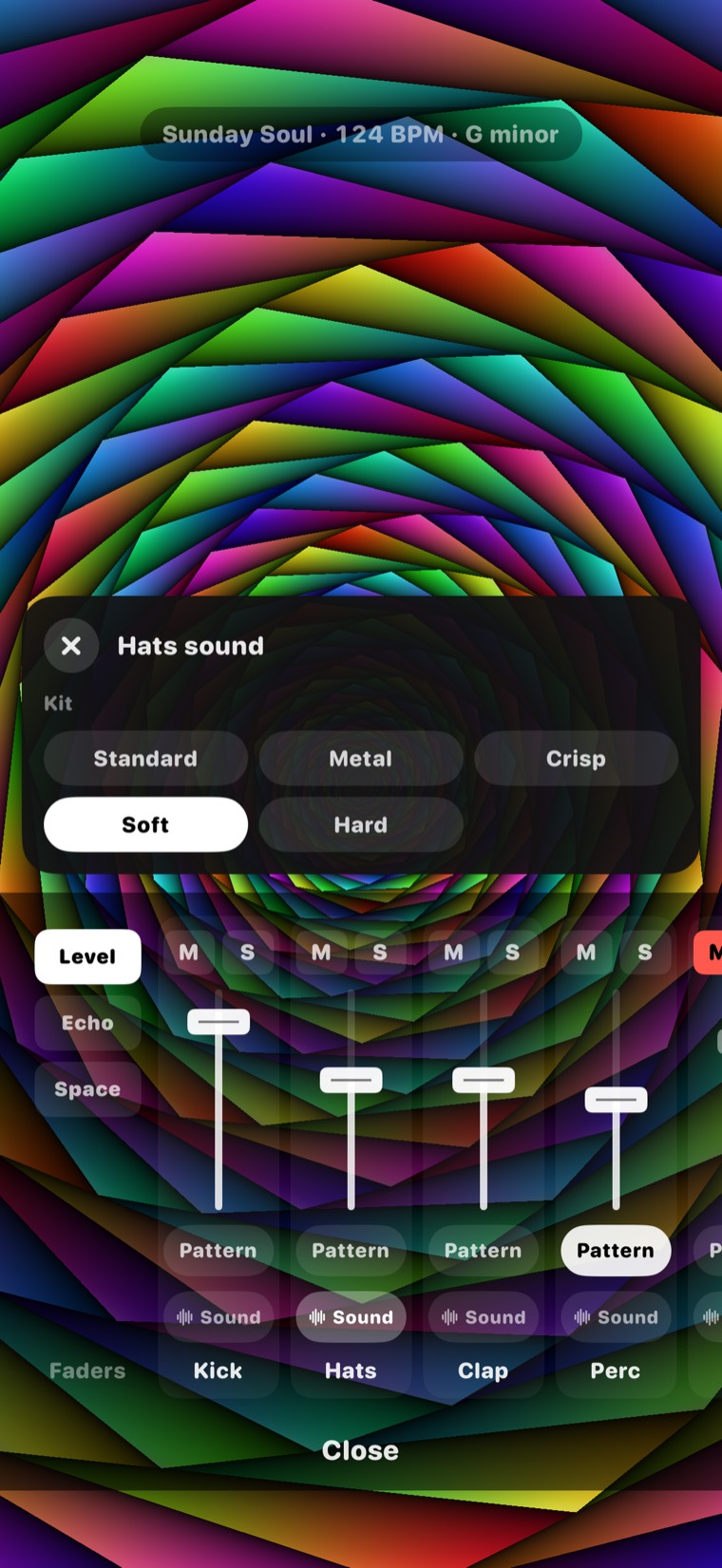
Polygons inside polygons for ever, whirling into spirals as you play.
The tracks you save and the room settings you choose to keep live in the app's own storage. Recordings go to your photo library. That is the complete list.
We don't collect it. We don't see it. There is no server for it to go to.
Calabi makes no network connections at all: no account, no analytics, no advertising, no crash-reporting service and no third-party SDKs. Apple handles the purchase, so we never see your name or payment details. If you've chosen to share analytics with developers in your device's settings, Apple may pass us anonymous, aggregate figures — that's Apple's switch, and you can turn it off.
Open it and play. There is nothing to register and nothing to log in to.
Calabi doesn't use the microphone. The music is generated on the device, not captured.
Clips go to your photo library, in a Calabi album. The app asks to add there and to find that album again; it doesn't look at your other photos, and keeps no copy.
Every sound and every picture is made on your iPhone or iPad, so nothing is streamed or downloaded, and it plays anywhere.
ⓘ → Your data deletes all your tracks or resets every room. Deleting the app removes the rest; recordings stay in Photos until you delete them.
No advertising, no tracking, nothing that profiles you. The full policy is here.
One app for iPhone and iPad, and on iPad it turns any way round. Plug either into a TV or projector and the room's picture fills that screen at the screen's own resolution — up to 4K — while the controls stay in your hands.
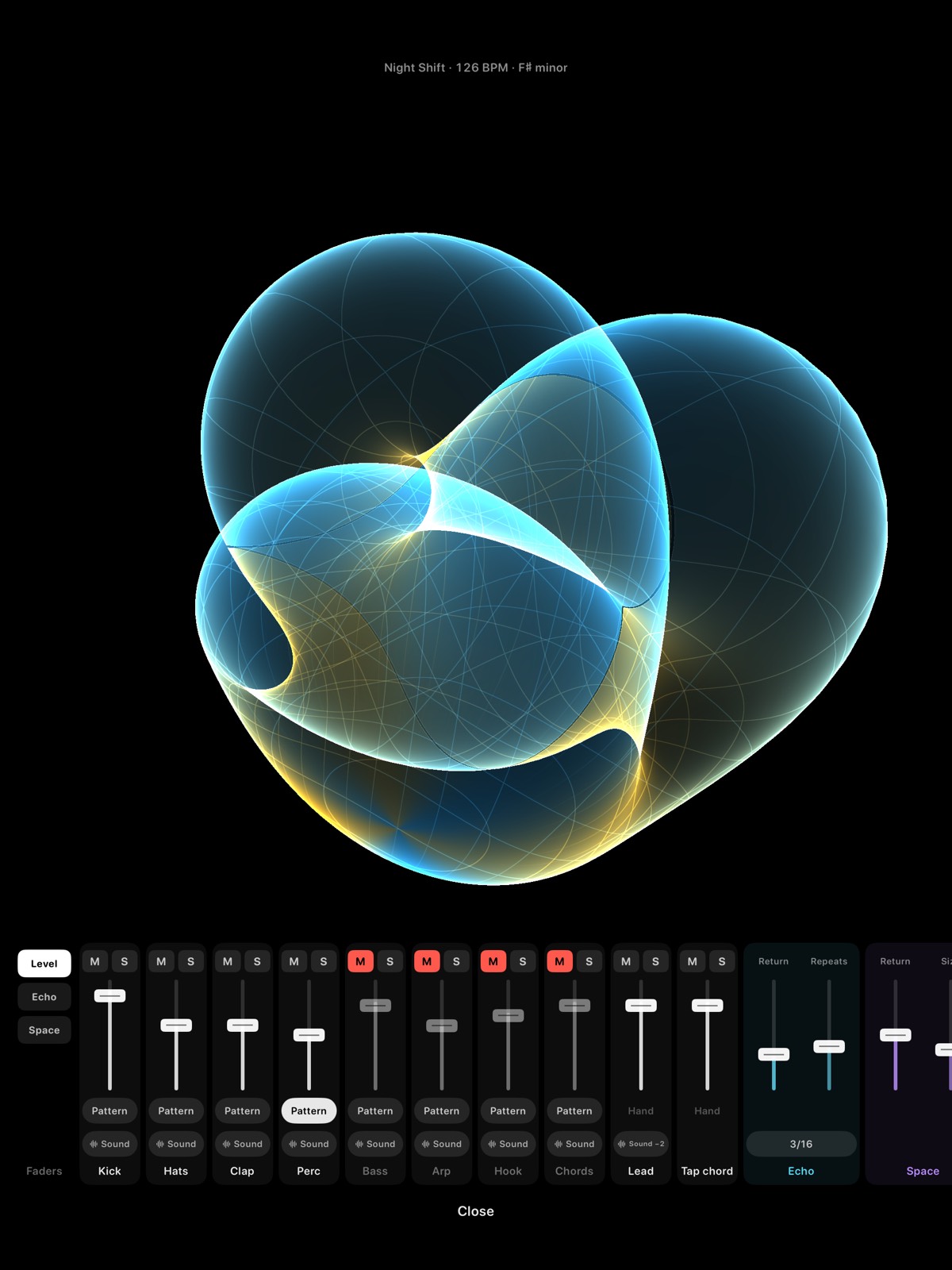
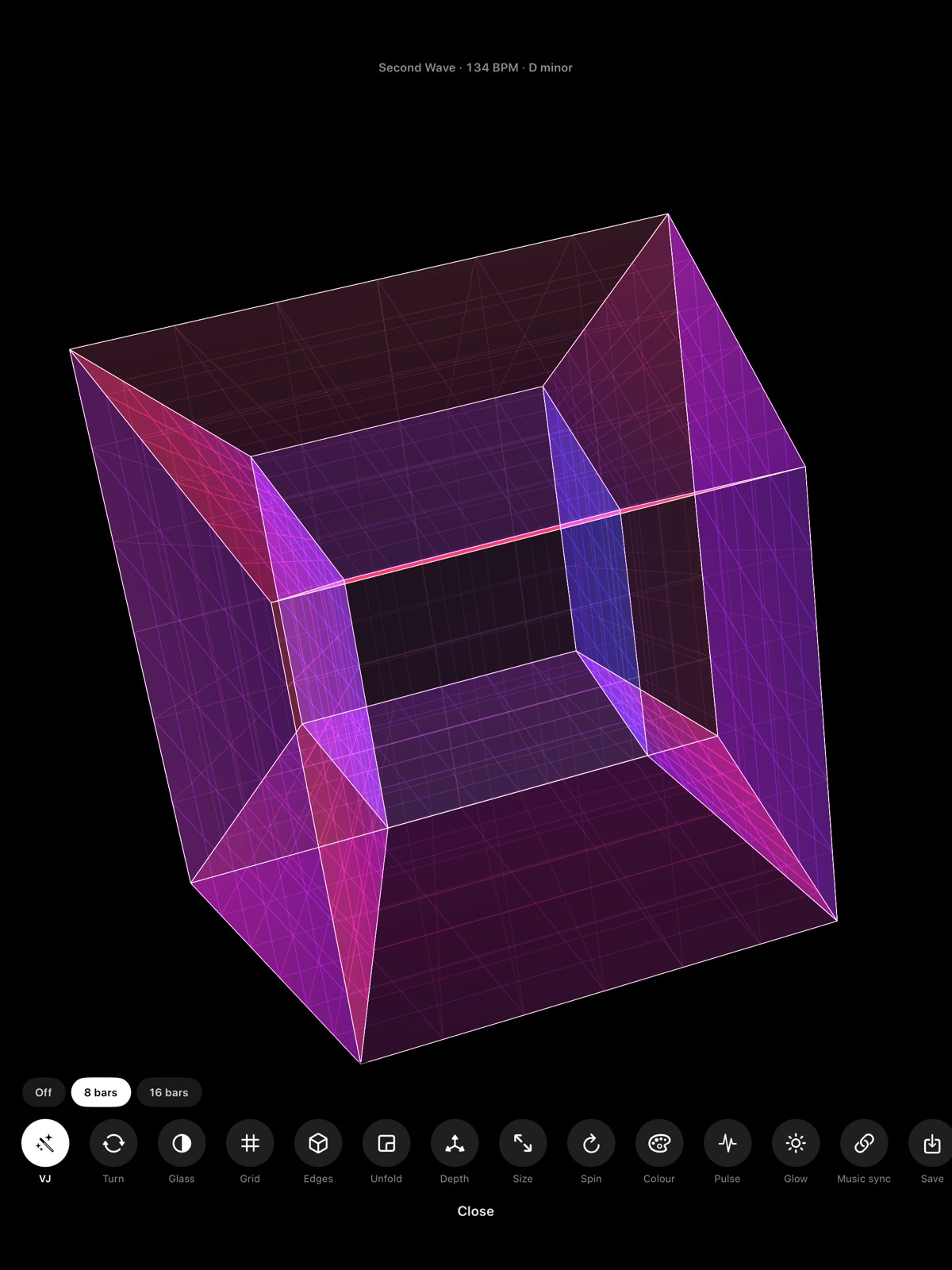
A connected screen gets a window of its own, drawn for that screen, rather than a copy of your device with the buttons on it. You'll need a cable or adapter that carries video, such as USB-C to HDMI — most charging cables don't.
DJ arranges the track in phrases of eight or sixteen bars — parts in, a breakdown, a snare roll, the drop. VJ moves the room's settings on every phrase. Turn both on and walk away.
Tap Record and it counts in — three, two, one — then starts the music from the top of a bar, so every clip begins on the beat, with the app's own music on it.
The music carries on with the screen off, the way any music app does.
All twenty-two rooms, all twenty-two tracks, the full mixer, recording and big screens — £2.99, once, from the App Store. No subscription, nothing to buy inside the app, nothing that renews.
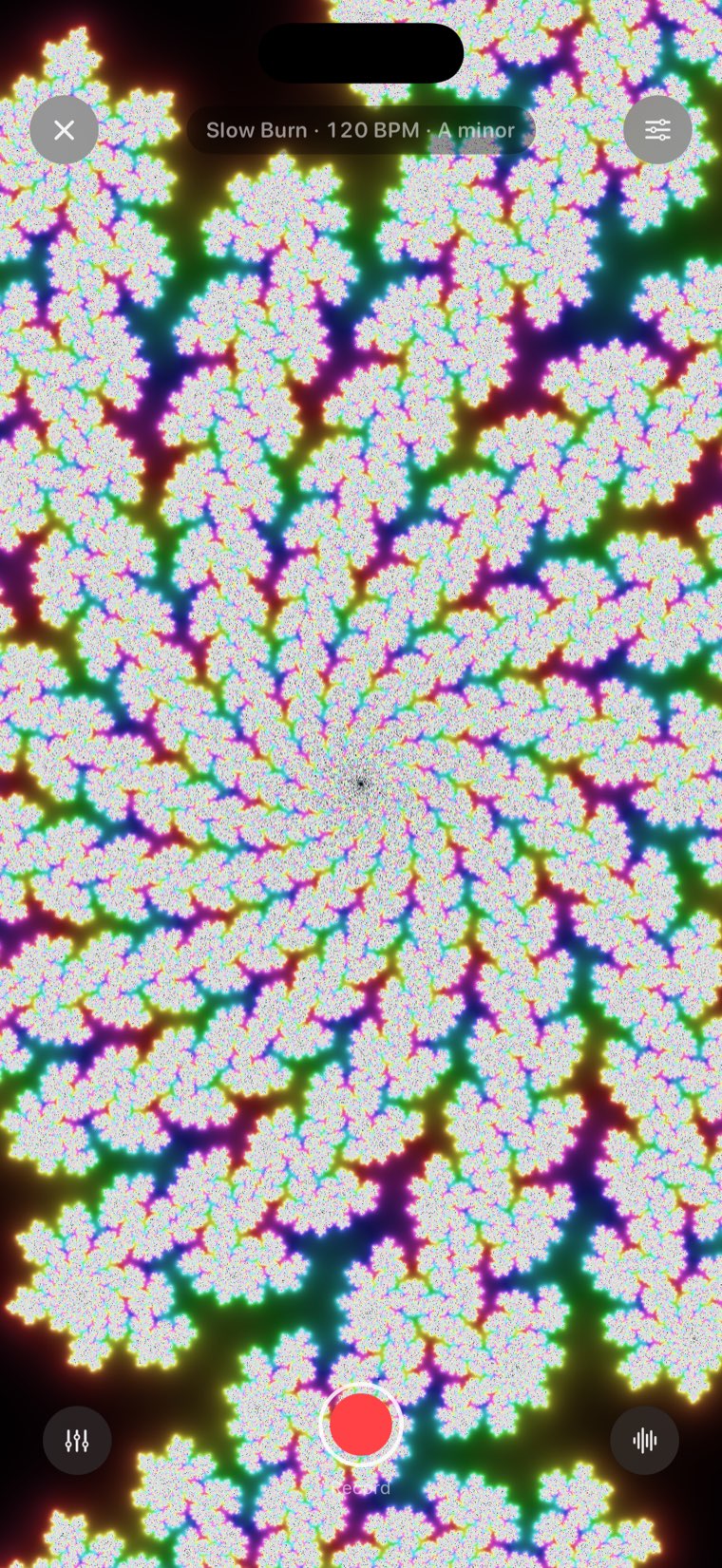
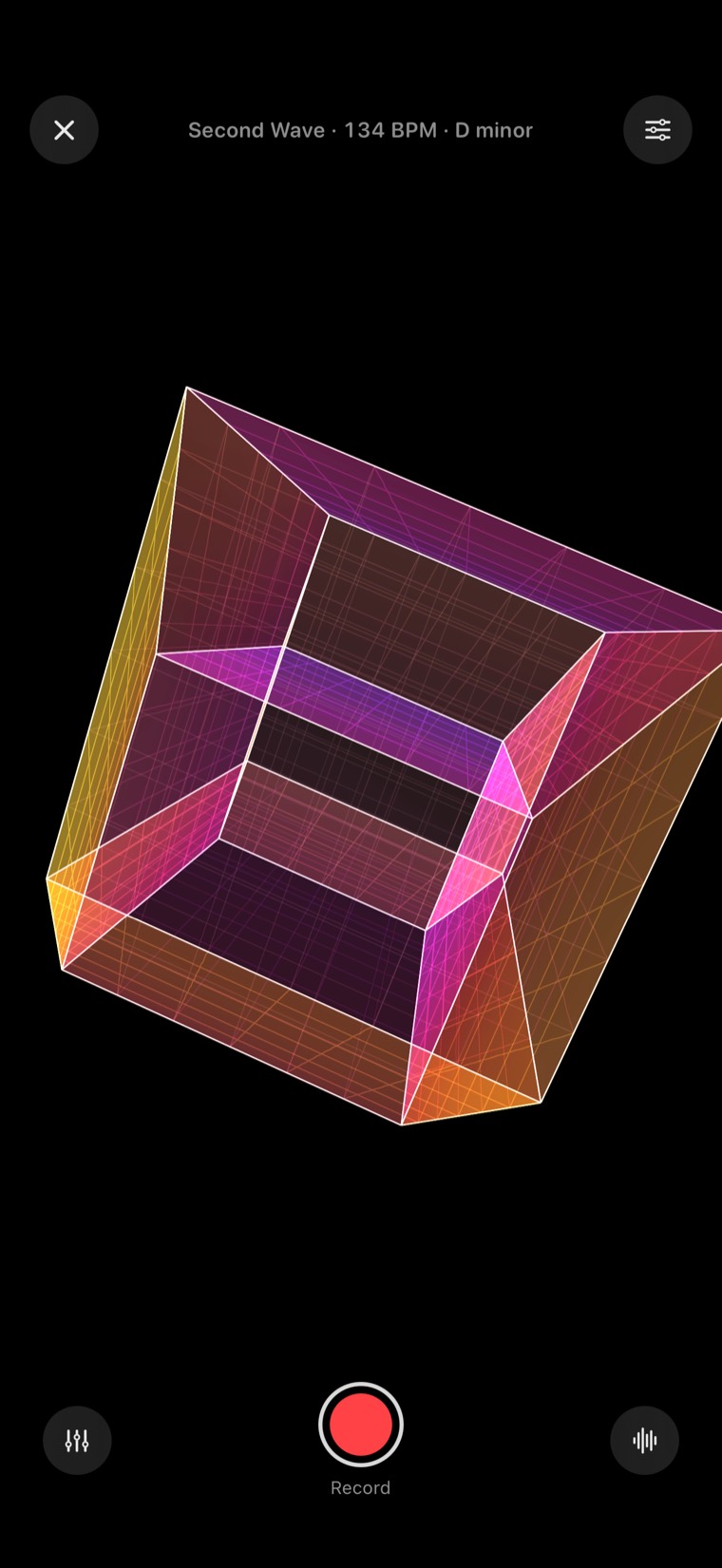
Real screens, not mock-ups.
£2.99 once, and after that there is nothing else to buy.
Apple handles the purchase and any refund. We never see your payment details.
No subscription, no packs, no adverts, and no rooms waiting behind a paywall.
Needs an iPhone or iPad on iOS 17 or later — and nothing else.
Prices shown in GBP. The App Store sets its own price in each territory, so yours may differ — Apple shows it in your currency before you pay.
Questions: hello@mixudg.com, or read the support page.